
Published:
2006-01-02
Updated:
2013-09-04
Learning Ukulele with Curt
Reading Music on `Ukulele Series - Reading in Open Position, Introduction
There are a few things in music that students and players avoid. These are things like learning to read and knowing the notes of their own instrument. It is hard on guitar - but not so hard on ukulele. With the right guidance and plan of attack. IT IS EASY. It is really quite easy on a uke. Starting with natural notes in in the open position you can finally check off the Reading Music to do item. Learning to read standard music notation is really, really easy.
Author(s): Curt Sheller Publisher: Curt Sheller Publications Code: UKEREAD1P-L1
Main Category: Reading Main Instrument: Ukulele
Subjects: Chords

2026-08-23
RelatedLessonAssets
Show Series Lessons
Series Home
If you're a registered site member and have the correct permissions you can view ALL the pages of this PDF or Samples pages at a larger size using the LearningUkulele.com Online PDF Viewer.
This Download is NOT part of your LearningUkulele.com and Learning Ukulele with Curt membership level.
Sign-up for Premium Site Access or Upgrade Your Plan to download this PDF or your can purchase a copy for download
Register/Sign In for Access…After purchasing a PDF a download link or PDF link will be sent to you.
Contact LearningUkulele.com and Learning Ukulele with Curt if there are any issues.
There are a few things in music that students and players avoid. These are things like learning to read and knowing the notes of their own instrument. It is hard on guitar - but not so hard on ukulele. With the right guidance and plan of attack. IT IS EASY. It is really quite easy on a uke. Starting with natural notes in in the open position you can finally check off the Reading Music to do item. Learning to read standard music notation is really, really easy.
It is really quite easy on a uke. Starting with natural notes in in the open position you can finally check off the Reading Music to do item.
Learning to read standard music notation is really, really easy.
Reading is the ability to reproduce music from written notation. It includes five phases; note recognition / alternate note locations, rhythm recognition, fingering considerations, communication terminology and interpretation.
There are two levels of reading. One is sight reading, the ability to reading a piece of music on demand with out ever seeing it before. This is what studio and show musicians do all the time. The other is, to be able to read to figure it out and learn learn a piece of music for performance or reference.
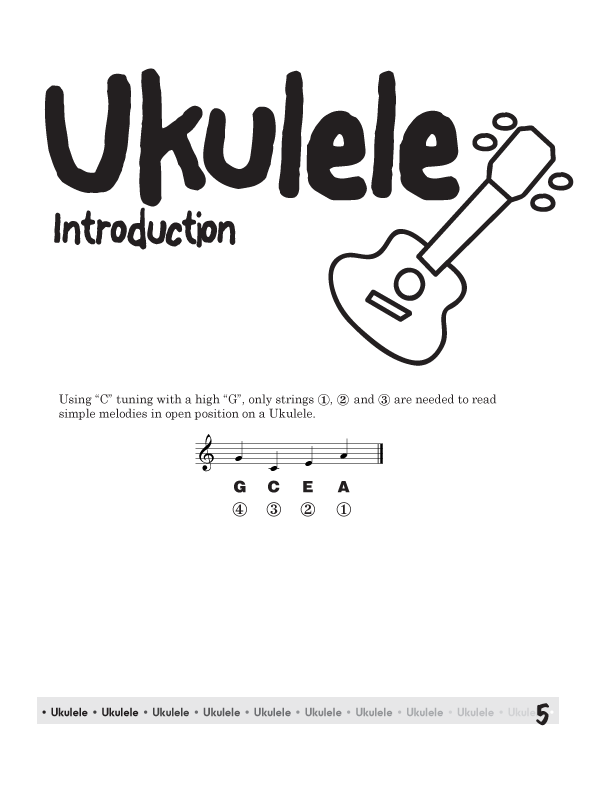
Reading standard music notation in open position on the ukulele is a lot easier than on guitar. It only has four strings and a limited range. In open position in C Tuning with a high G for string four, the range is middle C on string three open to C above middle C on string one, fret three.
String Four
There are two common “C” tunings for ukulele. One with a high “G” string 4 and another with a low “G” string 4.
Here is a lessons that compares the two tunings:
Alternate Note Locations
When using a high "G", C Tuning, string four contains alternate note locations for G A and B in open position. These are alternation locations of the G A and B notes found on strings two and one.
Related Books
Related Books for Reading Music on `Ukulele Series - Reading in Open Position, Introduction

Related Related Series
Related Related Series for Reading Music on `Ukulele Series - Reading in Open Position, Introduction
Reading Music on Ukulele - Primer
In the realm of music, there are certain aspects that students and players often tend to avoid. These include skills such as learning to read music and familiarizing themselves with the notes on their instrument. While these tasks may seem challenging, particularly on the fretted string instruments, they are comparatively easier on the ukulele. With the appropriate guidance and a well-defined plan, mastering these skills can be a smooth and achievable process.
Six Secrets of Ukulele Fingering Series
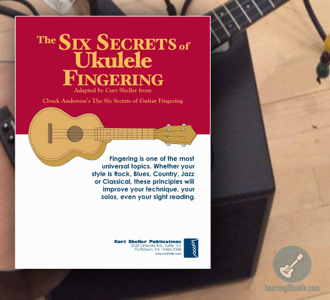
Learn the six fingering principles to navigating the ukulele fingerboard. Fingering is one of the most universal topics. Whether your style is Rock, Blues, Country, Jazz or Classical, these principles will improve your technique, your solos, even your sight reading. Think of fingering as a series of pathways. When you learn to connect these pathways, there are benefits not only to technique but also to creativity. All fingering on the ukulele can be reduced to 6 principles of motion. Each principle has physical and musical characteristics that you can use to improve your playing.